Roadwurx Launches Municipal Referral Program to Reward Highway Departments for Sharing Success

Published on June 28, 2025
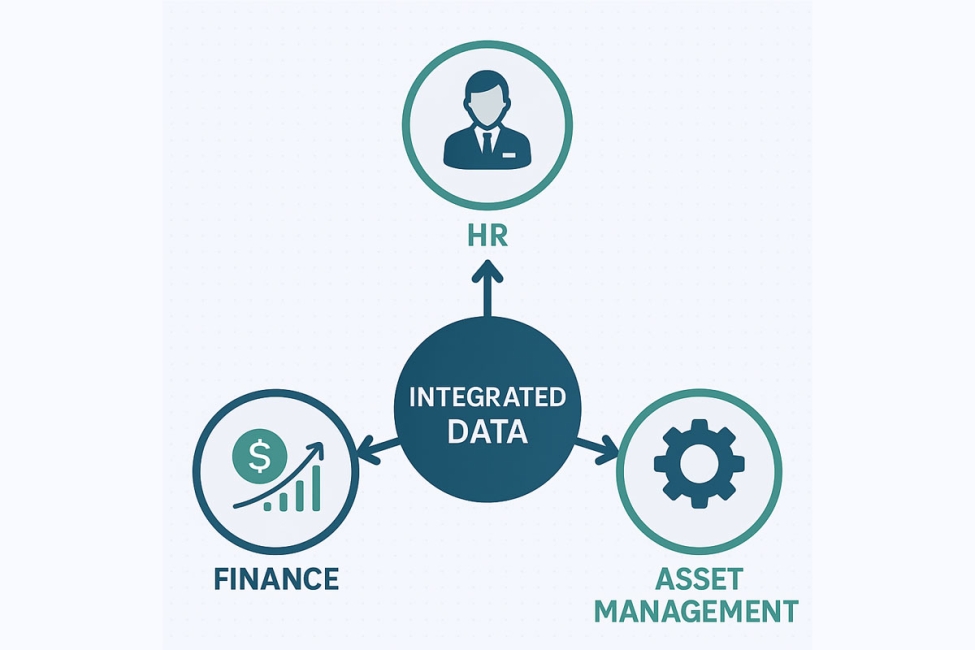
Municipalities and government agencies often operate with siloed systems for finance, human resources, and asset management. While each department’s software can excel in its specific domain, disconnected platforms lead to duplicated data entry, conflicting records, and inefficiencies that waste staff time and taxpayer dollars. Integrating these systems creates a single source of truth and paves the way for better decision-making, increased productivity, and improved compliance.
Separate systems mean employee information, asset records, and budget data are manually entered multiple times across finance, HR, and asset management tools. For example, when onboarding a new staff member, HR creates a record, finance inputs payroll data separately, and asset management assigns equipment, each often requiring redundant data entry. Any discrepancy among these systems can result in payroll errors, compliance issues, or misallocated assets.
1. Centralized Data Management
A shared database ensures each department accesses and updates the same information, reducing errors and the need for reconciliation.
2. Streamlined Workflows
Automating data transfers between systems speeds up onboarding, procurement, and budgeting processes.
3. Enhanced Reporting and Compliance
Integrated data enables more comprehensive financial and operational reports, helping municipalities stay ahead of audits and compliance requirements.
4. Cost Savings
Reducing manual work frees staff for higher-value tasks, and fewer errors lower the costs associated with corrections or fines.
Adopt Unified ERP Platforms: Enterprise Resource Planning (ERP) solutions tailored for municipalities often include modules for finance, HR, and asset management within a single system.
Use Middleware or APIs: If replacing existing systems is not feasible, middleware or application programming interfaces (APIs) can connect disparate platforms to synchronize key data fields.
Define Data Standards: Establishing common data formats and terminology across departments reduces ambiguity when integrating or migrating data.
Train Staff on Integrated Workflows: Ensure employees understand new processes to prevent old habits from recreating silos within an integrated system.
Upfront Costs: Integration projects can be expensive and may require additional IT staff or consultants.
Change Management: Staff resistance to new workflows is common. Successful integration depends on clear communication and leadership support.
Legacy Systems Compatibility: Older software may lack integration capabilities, requiring creative solutions or system upgrades.
For municipalities aiming to increase efficiency and reduce duplication of effort, integrating finance, HR, and asset management systems is a high-impact step. It minimizes errors, speeds processes, and supports transparency with constituents—key advantages for any modern local government.
Roadwurx Launches Municipal Referral Program to Reward Highway Departments for Sharing Success
Why Every Road Department Should Use Asset Management Software

Breaking Silos: Using Shared Dashboards for Cross-Departmental Visibility

5G + Edge Computing for Adaptive Traffic Signals
Computer Vision Pothole Detection

Open-Source Alternatives: When They Make Sense