Roadwurx Launches Municipal Referral Program to Reward Highway Departments for Sharing Success

Published on July 8, 2025
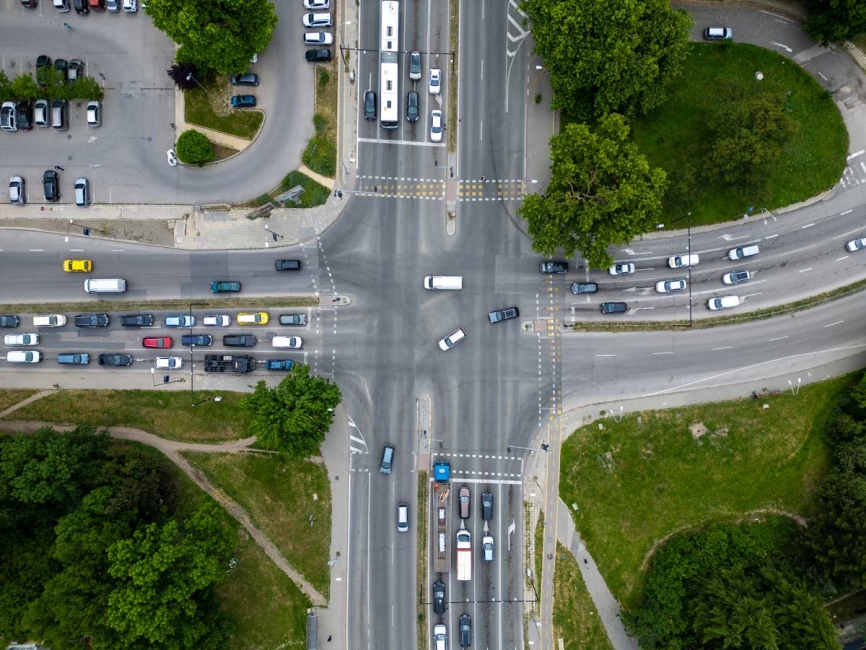
Adaptive traffic signal control is hardly new, yet most deployments still rely on fiber back-haul or Wi-Fi links that cannot guarantee millisecond response times. Pairing fifth-generation (5G) wireless networks with edge computing changes that equation by moving both connectivity and real-time analytics to the curbside cabinet, allowing signal timing to adapt to actual conditions as they unfold.
5G radios supply gigabit throughput and sub-10 ms latency. Multi-access edge computing (MEC) nodes placed at or near cell sites host the traffic-management algorithms, so video streams from intersection cameras and Lidar units never leave the local network. That architecture cuts round-trip delay, keeps sensitive data inside city limits, and removes the cost of hauling high-resolution feeds into a remote cloud. Verizon’s public and private 5G Edge platform, for example, is designed around these principles, promising low-latency closed-loop control for Internet-of-Things workloads such as adaptive signals [1].
Sensors, high-definition cameras, radar, Bluetooth probes, collect lane-by-lane volume, turning-movement counts, pedestrian presence, and even weather data.
Edge servers ingest the feeds, apply computer-vision models, and predict queue accumulation a few seconds ahead.
Signal controllers receive optimized phase and offset plans every cycle, rather than on the quarterly retiming schedule typical of legacy systems.
Because the compute is local, priority messages from emergency vehicles or transit buses can pre-empt the next cycle within a single second.
A 2025 framework published in the International Journal of Advanced Computer Science and Applications details how 5G-enabled edge nodes running congestion-prediction and route-optimization models outperform centralized clouds on both delay and energy use, especially when intersections are heterogeneous and data noisy [2].
Pittsburgh, Pennsylvania – The Surtrac adaptive network, currently being migrated to a private 5G testbed, has already cut travel time 26 percent and idling 41 percent across pilot corridors [3].
Verizon Edge Transportation Exchange (multi-state) – Pilots with state DOTs stream vehicle-to-everything (V2X) messages through MEC, letting connected cars and signals share situational data without costly roadside units [4].
Visakhapatnam, India – City police are introducing AI-based adaptive lights on five congested highway segments, aiming to replace manual signal control and automate violation detection [5].
Belval, Luxembourg (SmartSpires) – “Smart towers” equipped with 5G radios and edge servers run real-time mobility analytics, a model the EU hopes to replicate in other cities [6].
Real-time optimization can trim intersection delay, emissions, and fuel consumption; support pedestrian-safety features such as automatic walk extensions; feed live data to regional traffic management centers; and provide an upgrade path to connected- and autonomous-vehicle (CAV) applications without rewiring older signal cabinets.
Municipalities must secure carrier coverage (or deploy a private 5G network), back up edge nodes with battery or generator power, and adopt cybersecurity “zero trust” practices for roadside devices. Integration with existing NEMA TS2 or ATC controllers typically requires middleware from vendors such as Miovision, Econolite, or Yunex. Grants like the U.S. FHWA’s ATCMTD or EU CEF Digital can offset capital costs, while service-level agreements with providers spell out latency and uptime guarantees.
The biggest hurdles are up-front costs for radios and edge hardware, scarce in-house networking talent, and ensuring that future C-V2X or DSRC standards remain interoperable with today’s deployments. Placing compute at the edge also expands the city’s cybersecurity perimeter; regular patching and device-identity management become mandatory.
5G and edge computing turn adaptive traffic signals from a promising idea into an always-on civic utility. Early pilots show double-digit reductions in delay and emissions, and the same infrastructure lays the groundwork for CAV services, environmental monitoring, and even curb-side revenue applications. Cities that are already retiming signals or upgrading cabinets should evaluate whether MEC and carrier-hosted 5G can shorten installation timelines and deliver measurable performance gains, provided that funding and security plans are locked in from the outset.
Verizon, “5G Edge,” accessed July 2025. (verizon.com)
Talbi C. et al., “Machine Learning and 5G Edge Computing for Intelligent Traffic Management,” IJACSA, vol 16 no 6, 2025. (thesai.org)
IoT For All, “5G and Edge AI: Tackling Traffic Management,” Dec 2 2024. (iotforall.com)
TS2 Tech, “Edge Computing Global News & Trends Roundup,” July 2 2025 (Verizon Edge Transportation Exchange). (ts2.tech)
Times of India, “Real-time adaptive traffic signals to come up at major junctions in Vizag,” July 8 2025. (timesofindia.indiatimes.com)
TS2 Tech, ibid. (SmartSpires Luxembourg pilot). (ts2.tech)

Roadwurx Launches Municipal Referral Program to Reward Highway Departments for Sharing Success

Why Every Road Department Should Use Asset Management Software

Breaking Silos: Using Shared Dashboards for Cross-Departmental Visibility

5G + Edge Computing for Adaptive Traffic Signals
Computer Vision Pothole Detection

Open-Source Alternatives: When They Make Sense